Secrets of the forest: get to know Ibiti's trees and their stories

Walking along the Ibiti trails is also a journey through time: each tree tells a story of regeneration, shelter and beauty. Their preservation begins with knowledge and respect for the environment. Ibiti's trees hold legends, meanings and are true guardians of the forest, providing shade, shelter and food for all living beings. And, of course, they are enchanting! Researchers who have been here have catalogued hundreds of species, including ipê-amarelo, quaresmeira, paineira, embaúba, mulungu, candeia, among many others. Many of these trees are marked with plaques, making them easy to recognize during your walk. Others are the protagonists of stories told by guides and local residents. Here are some of the most emblematic trees within the Ibiti Projeto territory, all recorded by the passionate eyes of visitors and project collaborators! Ipê-amarelo Native to South America and very present in Brazil, the ipê-amarelo is celebrated for the exuberance of its flowers which bloom at the end of winter, making it a true national symbol. Between August and September, it colors the forests of Ibiti and enchants visitors. The flowers, considered edible, are used by some chefs in gastronomy. And they attract various insects, bees and birds, especially hummingbirds, which play an essential role in pollination. Quaresmeira An ornamental tree native to Brazil, especially the Atlantic Forest. It usually blooms during the Lenten season, which gives it its popular name, attracting attention in the middle of the forest with its showy purple or pink flowers. Araucaria At the Mirante do Cruzeiro, 42 araucaria saplings have been planted, forming the symbol of peace. This species, which stands out in the landscape on the way to Areião, has existed on the planet for around 200 million years. It flowers between October and December. It produces pine cones that contain the pine nut, which ripens between April and June and serves as food for animals, such as the blue jay, and humans. Jequitibá At Ibiti, two saplings were planted: one at Engenho Lodge and the other at Vila Mogol, in front of the Yucca restaurant. An Atlantic Forest heritage tree, the jequitibá - which can live for more than 500 years - reflects Ibiti Projeto's commitment to longevity and sustainability. It is among the tallest trees in the Brazilian flora, reaching heights of 50 to 60 meters. It provides shelter and food for various species of fauna, which take advantage of its fruit and the protection of its high branches. Mulungu Present in several areas of Ibiti, this tree is endemic to Brazil and is known as much for its medicinal properties as for its beauty. Also called parrot's beak, it is traditionally used as a natural calming agent and can be found in teas, capsules or tinctures. Between June and September, it blooms in vibrant red tones while shedding its leaves, attracting mainly hummingbirds. Sapopema (Tree of the Seven Horsemen) A sapopema tree over 350 years old with a hollow trunk arouses the curiosity of those who pass by on the trail in the middle of the forest near Garnet. Legend has it that, during a heavy storm, seven travelers found shelter inside, arousing curiosity about the thickness of its hollow trunk. Its fruits are woody capsules that open to release winged seeds. Candeia Native to the Cerrado and Rupestrian Fields, the candeia has resistant and aromatic wood, rich in essential oil used in folk medicine and the cosmetics industry. Its white or yellowish flowers bloom between March and May. Juçara The juçara palm is essential for forest regeneration, but is threatened by palm heart extraction. In Ibiti, its fruits are used to produce juçaí (similar to açaí), jellies and ice cream, while the seeds are reintroduced into the wild, encouraging conservation. In Vila Mogol, several seedlings were planted with the involvement of the community, which also takes part in the Juçara Festival. Paineira Among the statues and the Garnet, a majestic specimen of paineira stands out, whose trunk and flowers attract attention in the landscape. It blooms profusely in summer and fall. The fruits are large and, when ripe, release silky millet.
The Long Run: Ibiti hosts global meeting on regeneration

Development and nature go hand in hand. This is the motto of the Annual Members Meeting 2025 of The Long Run network, which will take place from October 26 to 30, 2025 at Ibiti Projeto, in Minas Gerais, bringing together some of the most committed destinations on the planet with conservation, culture, community and conscious commerce: the 4Cs that guide the network's philosophy. Founded under the umbrella of the Zeitz Foundation, The Long Run connects and supports enterprises that act as guardians of ecosystems and agents of social transformation. Today, the network protects millions of hectares of natural areas around the world and influences policies, practices and investments aimed at positive impact tourism. The central theme of this year's meeting is “Resilient Commerce for Lasting Impact Across the 4Cs”. For five days, Ibiti will be the setting for panels, immersions and experiences that unite business and nature, exploring themes such as “Entrepreneurship and inclusion as drivers of regeneration”, “Connecting landscapes and leaders for systemic change”, and “Ethics, integrity and the future of conservation”. Participants Among the names confirmed are Stephan Bruckner (Wolwedans, Namibia), Roberto Klabin (Caiman Pantanal, Brazil), Thais Corral (Sinal do Vale, Brazil), Michael Dyer (Borana Lodge, Kenya), Philippa Roe (Six Senses Laamu, Maldives) and Wouter Jordaan (Tswalu Kalahari, South Africa), as well as representatives of biological reserves, private islands and regenerative initiatives from Latin America, Africa and Asia. The meeting's experiences include sunrise yoga, trails through Ibiti's waterfalls and forests, visits to Vila de Mogol, meetings with local entrepreneurs and a special stop at Casa dos Muriquis, where biologist Fabiano de Melo presents the pioneering assisted reproduction project for the largest primate in the Americas. The “Beyond the Obvious” panel will feature Claudia Baumgratz (Ibiti Engenho Lodge), Joaquim Monteiro (Sertões MTB) and Alex Soderberg (Ibiti Vegan), discussing how Ibiti extends its mission of regeneration through events and experiences that inspire different audiences. On the right track “Hosting The Long Run meeting at Ibiti is confirmation that we are on the right track. We share with this community the belief that regenerating is a verb that is conjugated with actions, and that tourism can be a powerful force for transformation.” “Regenerative destinations lead by example, showing that tourism can be a force for good. Our members are not afraid to ask tough questions, talk about failures, share lessons learned and build on them, because real progress requires honesty and courage. After all, the value we offer guests lies in the uniqueness of our landscapes and the authenticity of our connections, which makes us natural guardians of ecosystems, cultures and the communities that protect them.” Regarding the future and the impact of the event, Johanna Barba says: “We hope that participants will leave Ibiti inspired by both the place and the people. The program has been designed to reflect Ibiti's bold spirit, its creativity in building community, its deep respect for nature and its celebration of culture in all its forms. These days are designed to spark new ideas and challenge us to think differently about regeneration in practice. But more than that, we hope everyone leaves with a renewed sense of connection to each other and to the shared mission we have as members of The Long Run. What makes this community special is its authenticity: a space for honest exchanges, without ego or pretension, where we can reconnect, recharge our energies and strengthen our collective capacity to create positive change.” The closing speech will be given by Hugo Cambraia, CEO of Ibiti Projeto, presenting the Ibiti Regenera program, a long-term initiative that symbolizes the project's commitment to the next 2,000 years of regeneration. The meeting of The Long Run in Ibiti represents the convergence of a community that collectively dreams, works and plans for the future.
Ibiti: A global example of regenerative hospitality

Ibiti Projeto is featured on Hospitality Net as a global reference in regenerative hospitality, uniting rewilding, community and innovation.
Tapir in Ibitipoca: New resident of Ibiti brings lessons about regeneration
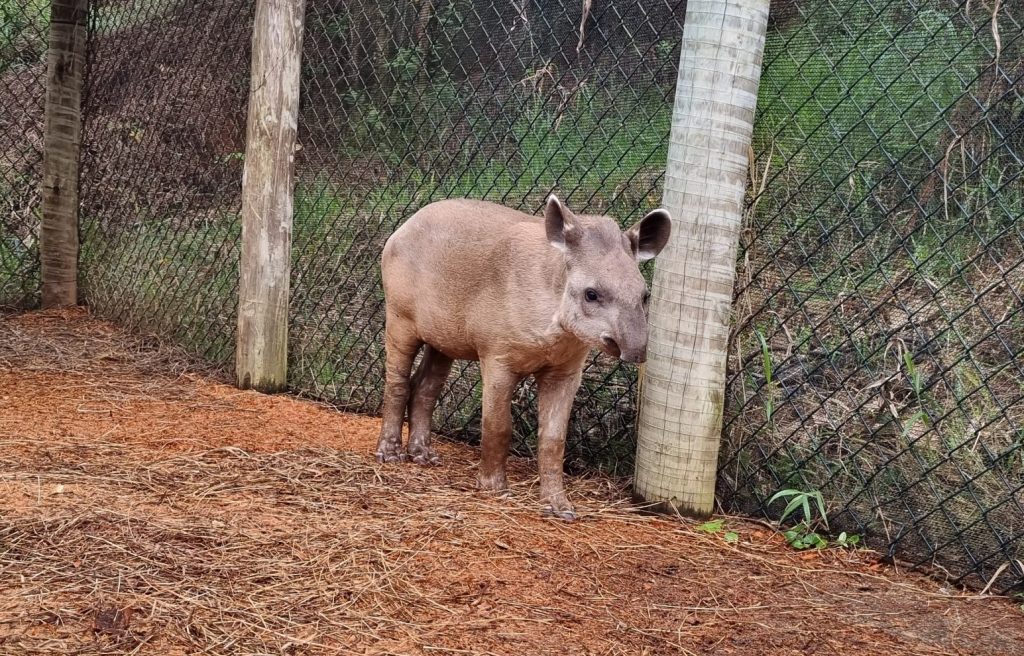
Meet Bambu, the baby tapir in Ibitipoca, an ambassador for preservation, and understand the importance of this species for biodiversity