
Spinoza's portal: Nature as a temple
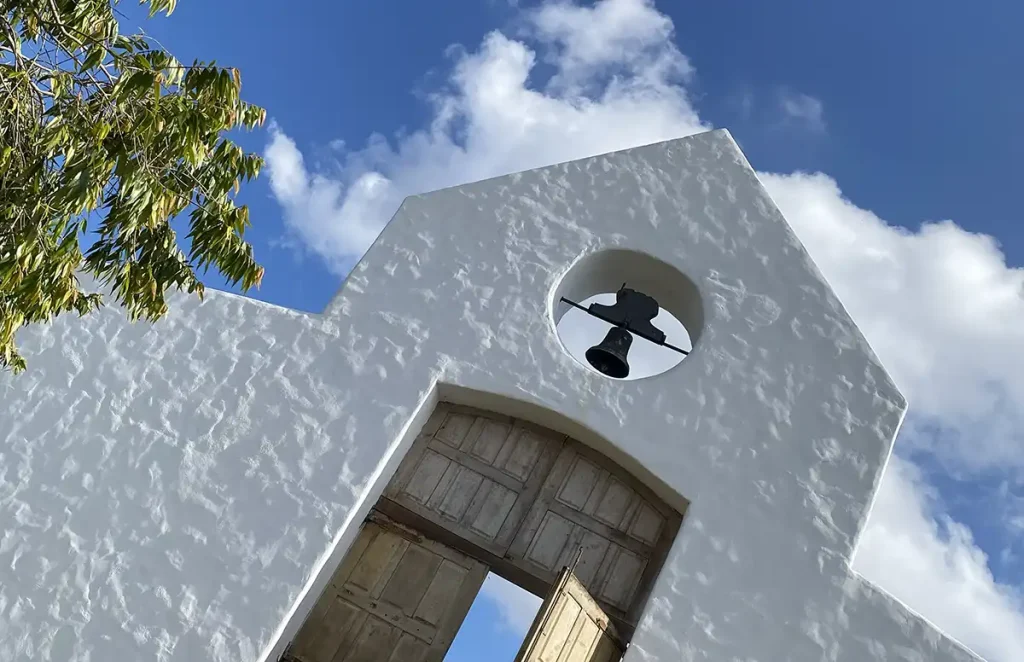
Between philosophy and infinity, a symbol stands out at the top of Ibiti. At the top of Chapadinho at an altitude of 1,200 meters, a white and silent structure invites contemplation. It is the Portal of Spinoza, which combines architecture, philosophy and spirituality in perfect harmony with the landscape. From afar, the façade resembles that of a church. Up close, it reveals a monumental six-meter-high door, acquired more than 20 years ago. The bell rests at the top, completing the scene that unites the sacred and the earthly. The vision behind the Portal The inspiration came from a simple image. Renato Machado, creator of Ibiti Projeto, saw a church façade in the Northeast, remembered the old doors and, as he was reading "Spinoza's Secret", came up with the idea for the building. "You open the portal and see God, because if you can't see God in that wonderful view, you won't find God anywhere," he said, agreeing with the philosopher. Here, the beauty of nature is the very experience of the divine. Harmony and contemplation According to engineer Hugo Cambraia, the portal follows the proportions of the golden ratio, a principle that governs the most harmonious forms found in nature and the arts. It is 16 meters long, 11 meters high and just 1 meter wide, measures that reflect perfect balance and proportion. Made of masonry, the monument fits into the terrain, from where you can see a 360-degree panorama. From there you can see the eastern slope of the Ibitipoca State Park, Areião, Pico do Peão, the Pão de Angu and Cabeça de Formiga hills, the town of Pedro Teixeira and, in the distance, the lights of Juiz de Fora. On clear days, the view reaches as far as Pico da Bandeira, in the Serra do Caparaó. Deus sive Natura The name of the Portal pays homage to Baruch Spinoza (1632-1677), the Dutch philosopher who redefined the notion of God and inaugurated a new form of spirituality. For Spinoza, God and Nature are one and the same reality, an infinite substance that manifests itself in everything that exists. "Everything that exists exists in God, and without God nothing can exist or be conceived," he wrote in his masterpiece, Ethics. Unlike the traditions that place the divine outside the world, Spinoza saw it in every mountain, in every stone, in every thought. Human freedom, he said, lies in understanding the laws of nature and living in harmony with them. For this reason, Spinoza's Portal is more than a viewpoint: it is a symbolic crossing between the rational and the contemplative, between thought and the direct experience of the sacred. A living space The space can host meditations, yoga practices, soundhealing, contemplative breakfasts, meetings and sunrise ceremonies. The place also serves as a backdrop for personalized events, such as celebrations and weddings, where the decoration is nature itself. Find out more ibiti.com @ibitiprojeto @ibiti.village @ibitiengenho